

Beaver by water Adobe stock image
Wild beavers in Staffordshire
In February 2025 the Government sanctioned the release of wild beavers. This means that with a licence beavers can be released in suitable areas, and at Staffordshire Wildlife Trust we’ve been progressing towards making an application to do this in the county.
However, there are already a small number of wild beavers in Staffordshire, which we’re closely monitoring. We don’t know where these beavers came from. We’ve seen beaver activity on the River Trent, the River Dove, the River Sow and the River Tame. We believe there are several adult beavers, including two pairs.
Wild beavers in Staffordshire (https://youtu.be/eJoXOfpress )
A compilation of trail cam clips showing wild beavers in Staffordshire
Our top priorities are to continue to monitor the beaver activity, and their impact, and to keep in close contact with local landowners and conservation partners.
Why are beavers good for Staffordshire?
Beavers are a nationally protected species and will bring many benefits with their wetland engineering work. In the right places their presence can positively influence the surrounding landscape. They are a keystone species – this means they define entire ecosystems - greatly improving wetlands for other wildlife and people. More widely they can benefit society through their ecosystem services – improving water quality and slowing down flood waters.
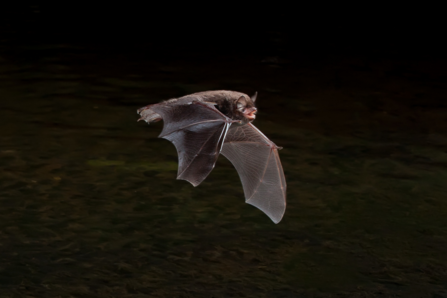
Beavers have been proven to boost habitats and allow an abundance of other wildlife to thrive. For example, beavers could boost dragonfly species by up to seven times, and areas with beavers have seen bird species and abundance increase up to 100 metres away. Evidence from other UK release sites has shown up to a 400% increase in bat activity, including species such as the Daubenton's bat. Beavers offer a natural solution to nature restoration.
A monumental moment
In spring 2026 (on World Beaver Day!) the Trust noticed one of the beavers it was monitoring on trail camera was lactating (her teats were enlarged). This indicated that she was feeding young. Next came an anxious wait, would the kit/s make it and would they be seen on camera? Kits are incredibly vulnerable to predation from mink and otter during their first few weeks.
Finally, in late June a kit was seen feeding on the trail camera. This is the first beaver born in the wild here in more than 400 years! As beavers/kits are impossible to tell apart there's no way of knowing if it's just one kit or a different one seen each time. Unless two are seen on camera at the same time, there's no way of knowing. But whether there is just one, or more, this is a very positive step for nature and shows that there is suitable habitat for beavers to thrive in Staffordshire.
Staffordshire beaver kit June 2026 (https://youtu.be/1FOms-HcPHw)
This video shows the first beaver born in the wild in Staffordshire in more than 400 years! Trail camera footage captured in June, 2026 by Staffordshire Wildlife Trust.
Recorded sightings of beavers in Staffordshire
The below map shows where we’ve received reports of beaver sightings or activity around the county since 2022. While each orange dot represents confirmed evidence of beavers, this doesn’t mean there are a corresponding number of beavers. We know that they can travel significant distances as they search out suitable habitat, so several records could be attributed to just one beaver.
Beavers aren’t easily distinguishable and sightings are often fleeting, which is why it’s so important we continue to monitor them using trail cameras. This footage has enabled us to establish that there are currently several lone beavers as well as three pairs living in Staffordshire.

A map produced by Staffordshire Ecological Record Centre showing evidence of beaver activity in Staffordshire from 2022 to February 2025. *Note each dot does not denote beaver population.
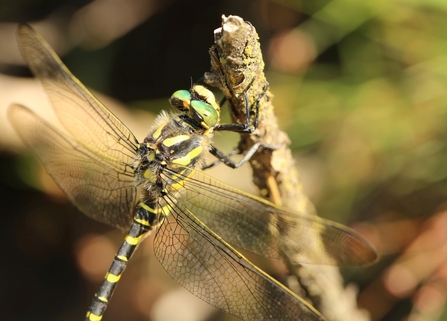
Golden-ringed dragonfly by Nick Mott/SWT

Willow tit by Harry Hogg
What we’re doing
We've been liaising with landowners over the last few years with the aim of bringing more wild beavers back to Staffordshire. This requires a licence from Natural England, so we’re working on a plan which will span the next 10 years. The release of more wild beavers will ensure Staffordshire beavers have good genetic diversity and increase the number of territories they occupy at a steady, measured pace.
We want beavers in Staffordshire, but we need to be strategic about where they are as far as we can be. There are several places within the county which would greatly benefit from their presence and wetland engineering work, including where some already are. It’s important that we continue to monitor their impact and work closely with local landowners to address any concerns.
As part of the licence application to Natural England we’ll continue to consult with other landowners and land managers. A crucial element will be to predict the benefits of the beavers to society; improvements to water quality, flood alleviation, replenishing aquifers and storing water during droughts. Equally important is outlining any potential problems. For example, damage to special trees, damage to crops, burrowing into flood banks or blocking culverts. Arrangements for ongoing management, mitigation measures and advice will be put in place
Increasing understanding
Another important element of our work is sharing information about beavers. Be it families with young children, school children or adults, we're helping people in Staffordshire get to know beavers. From how they're adapted for life in the water to why they create dams. How their presence has an impact on their surroundings and other creatures, we cover it all. Head over to our events page to find our next beaver activity.
How you can help
We’re keen to hear from anyone who thinks they’ve seen signs of beaver activity. Please keep an eye out for the below signs near waterways and wetlands and get in touch using our online report form if you find any signs of beavers. Include as much information as possible, including a What3Words location and photos of any signs of beavers you’ve found.
Signs of beavers
Feeding
Beavers are strictly vegetarian, they feed on woody and green vegetation, leaving a 45-degree angle on the stem. Large incisor teeth leave ridges in wood. They generally forage within 20 metres of the watercourse. They can go further, but don’t like travelling far from water. They mostly coppice smaller trees but they can sometimes fell mature trees. Below are some examples of the marks beavers leave on branches and trees.
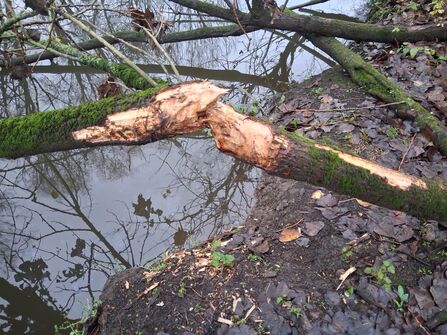
Signs of beavers feeding by Nick Mott
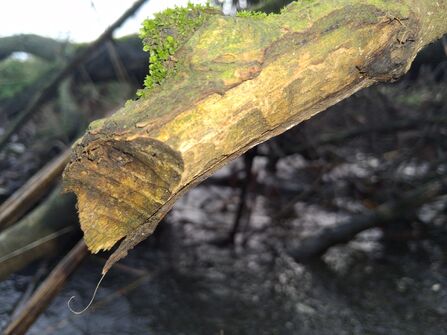
An example of teeth marks left by a beaver by Nick Mott. They leave a 45-degree angle on the stem.
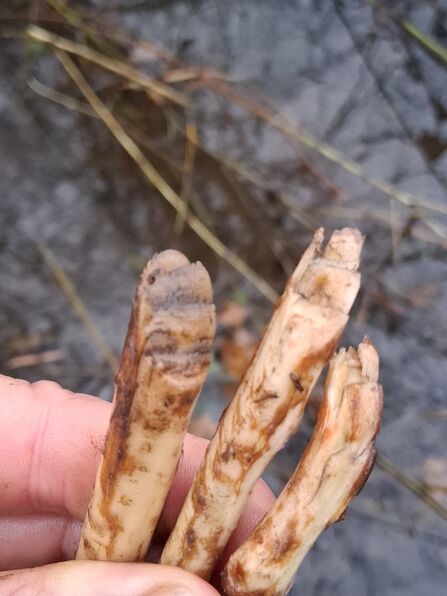
Example of beaver teeth marks on small branches by Nick Mott
Lodges

Example of a beaver lodge by Devon Wildlife Trust
Beavers live in burrows which they dig into riverbanks, or lodges they make from logs, sticks and mud. What they build and how many will depend on the river and size of their territory. Entrances to chambers and burrows are hidden underwater. If a chamber is exposed, beavers are likely to cover the hole with sticks and sediment.
Dams
Beavers build dams from sticks, large stones and sediment in small streams and watercourses. Look for sticks with a distinct 45 degree cut on the end (as for feeding signs). Sticks will be deliberately placed and tightly packed. They create dams to raise the water level behind the dam to make it deep enough for them. Beavers don’t always create dams and they can’t dam rivers when they are too wide, deep or fast-flowing.

An example of a beaver dam (Adobe stock image).
Landowner Advice
If you own or manage land where beavers are having an impact we’re here to help and support you with expert advice. Please use the online form linked below to get in touch if you’d like to talk to us about beavers on your land.
You can also find a lot of resources on the Beaver Management website linked below. This is a nationally run page with extenstive information on how to manage beaver-human conflicts.
Got more questions? We’ve gathered together some more information below.
Where are the wild beavers living?
We’re not able to give the exact locations of the beaver activity we’ve seen as we want to avoid disturbing them. Wherever they’ve come from, they’ve chosen areas which are secluded, fairly inaccessible to people and mostly on private land. This is because they are generally shy creatures and prefer to keep away from human activity.
Won’t all these beavers have a negative impact on fish by blocking waterways with their dams, particularly Atlantic salmon which need to travel upstream? And coarse fish too?
There has been a lot of research carried out into the potential impact of beavers on fish. Beaver dams affect migrating fish in different ways, and it really depends on the location and the time of year. When water levels are low, the dams can temporarily block fish from moving upstream, especially in straight, man‑made channels which is why we’re so keen to naturalise rivers in Staffordshire. But when the river is flowing higher, fish can often get past the dams. In more natural river settings, the pooled water can even create small side channels around a dam, giving fish another route to travel. The sheltered areas in and around the dams and the pools also provide safe nursery areas for young fish (fry). Beavers are a natural solution to improving the health of the river and to boost populations of all riverine species, including fish and in particular salmonids. For more information on this topic visit: https://beavertrust.org/our-work/beavers-and-fish/
You can also watch the Beaver Trust’s Film ‘Balancing the Scales’ over on Youtube https://www.youtube.com/live/uZE5fWMtpYc
Will the beavers mean we lose all our trees?
Beavers need woody vegetation to feed on. They eat the bark of trees and will fell trees to reach the leafy vegetation and to create dams and lodges. Beavers need a healthy ecosystem of riverside trees of various ages to support all their activities. The native broadleaved trees that naturally grow alongside our waterways do not die when they are felled by beavers, as they coppice. In much the same way that humans have carried out the traditional forestry method of coppicing; cutting the trunks down to the ground and allowing new stems to grow back, prolonging the lifetime of the tree. These new shoots also support invertebrate species that the older growth does not.
There are methods to protect important and valuable trees from beavers which we can advise on (more on our landowners and managers page).
Willow, the beavers' favourite, has another survival method that humans have taken advantage of. The cut stems can grow new roots from their bark and grow into a new tree, which is how willow has been propagated for hundreds of years to grow whips for hedges. When beavers target willow, not only does the original tree grow back, but any cut stems left lying uneaten or used to build dams root out and continue to grow into more trees. So beavers more often than not increase the number and longevity of trees in their environment.
I think I have beavers on my land, what should I do?
The most important question here is are the beavers having a positive or negative impact on your land? We’re on hand to advise and support you with any concerns so please get in touch. Please get in touch with our team by completing our request form here.
Please include as much information as possible, including a What3Words location. Our team are licenced and can help support landowners with coexisting with beavers.
It’s important to note that in 2022 beavers were recognised as a protected species in England and are listed in Schedule 2 of the Conservation of Habitats and Species Regulations 2017. This means it is an offence to deliberately capture, injure, kill or disturb beavers, or damage or destroy their breeding sites or resting places without a wildlife management licence from Natural England.
What do I do if I see signs of beavers?
Please report your findings to us using our online form here.
Will the beavers be found and caught? What would happen to them?
There are no plans to capture the beavers.
Could you catch these beavers and put them at Craddocks Moss?
We don’t know the origin of these wild beavers, so we don’t know if they are genetically diverse. It’s essential that the beavers at Craddocks Moss are not related, so our plan remains to bring beavers down from Scotland. This safeguards the beavers and ensures genetic diversity.
Why are you planning to release beavers at Craddocks Moss if there are already wild beavers?
It’s quite simple, we need them to halt sapling growth at Craddocks Moss. Beavers are a natural solution to nature restoration here. Without them, this special peat bog will be lost forever. They can transform it to a healthy state - so it helps not hinders the climate by storing huge amounts of carbon. Due to it previously being planted with conifers (since removed) it’s in poor condition. The bog is dangerous and inaccessible, making manual or mechanical removal of saplings and maintenance of bunds extremely difficult. Beavers will eat saplings and help maintain the wetland by damming breaches to the bunds of earth. These ecosystem engineers will help to restore Craddocks Moss into a thriving wetland rich in wildlife.


