Waxcap Wonders: Jewels of the Grassland

Waxcap Wonders: Jewels of the Grassland

Brightly coloured waxcaps are a group of fungi that take their name from the waxy texture of their caps. There are about 60 species of waxcap in the UK, home to roughly half the world’s population of waxcap species. Though not rare, they are an indication of unimproved grassland, of which there’s little left in Staffordshire, so seeing them is quite a treat. Read on to learn about a handful of waxcaps you could discover.

I absolutely love stumbling across waxcap fungi - they’re like hidden gems. These colourful mushrooms pop up in autumn, turning ordinary turf into a treasure chest. From bright scarlet to emerald green, waxcaps are nature’s way of showing off!

You’ll usually find them in old grasslands which have never been ploughed or treated with chemicals. Churchyards and meadows can be hotspots. They thrive where the soil is low in nutrients, which makes them a great indicator of healthy, traditional landscapes.

A small pale white/cream fungi among grass

Snowy waxcap by Sarah Davison

A pale beauty

The snowy waxcap is probably the only waxcap species that could reasonably be described a 'common' across Britain due to its ability to tolerate moderate amounts of artificial fertilisers that would eradicate most other waxcaps. I spotted the one pictured above while walking through a field near Uttoxeter last year.

What makes waxcaps so special? 

For one, they’re a sign that the land has been cared for in a way that supports wildlife. They’re also part of a fascinating ecological puzzle. Unlike many fungi, waxcaps don’t rely on rotting wood or forming partnerships with trees. Instead, they seem to have a complicated relationship with the soils. Current thinking is that waxcaps possibly have a relationship with mosses but investigations are still ongoing into this.

Spotting a waxcap feels like finding a secret. Often this splash of colour against the green can be a reminder that even the smallest things can tell big stories about our environment. So next time you’re out for a walk, keep your eyes peeled and you might just discover these little jewels hiding in the grass.

Witch's hat

Blackening waxcaps are currently under study as to whether they are colour variants or separate species. Usually they are found looking quite olive green (like the one pictured below by our volunteer John Stanney) with black patches developing until fully black and they usually have a very conical cap. This is why they are also sometimes known as witches hat! It’s the second most common waxcap after the snowy waxcap. It can be distinguished from other similar waxcaps by its long-lasting fruitbodies which, once mature, turn jet black all over and then can remain standing for many weeks.

An olive green fungi which is turning black among grass

Blackening waxcap by John Stanney

Beautiful ballerina

For some, the most beautiful of the waxcaps is the pink waxcap as shown below. This is much more scarce than the snowy and blackening waxcaps, so if you find one of these you are very lucky! You can sometimes spot them in small scattered clusters but they are often found alone. Pink waxcaps have a domed, pale pink cap on a white stalk. As they age, the cap often splits and turn into a distinctive upwards shape, hence it’s other common name, the ballerina waxcap.

Pink waxcap

Pink waxcap © Guy Edwardes/2020VISION

As dash of colour

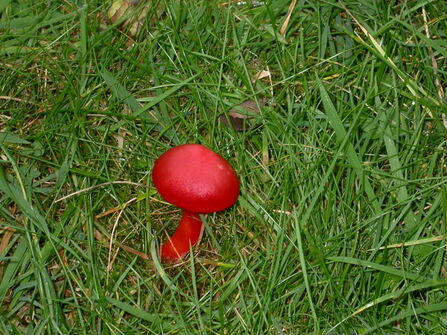
The scarlet waxcap is one of the smaller species of red waxcap fungi and can commonly be found on cropped grassland and in woodland clearings; it also occurs on old lawns and parks and in some well-managed churchyards (where no agri chemicals have been used). You have to be eagle-eyed to spot it as it is often only just peeking out of the grass but it’s a striking stunning scarlet colour so that helps.

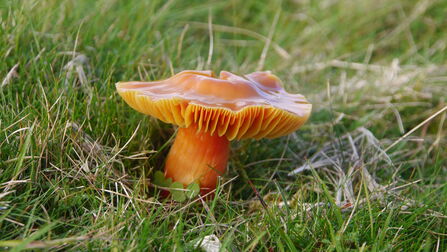
It is often confused with the crimson waxcap, also pictured below. This mushroom is typically larger, has a darker red cap and is much less common. Here's a beautiful example which Jackie Wragg, project manager for the Morridge Hills Country Landscape Recovery project found in the project area.

Gooey goodness

Last but not least is the stunning parrot waxcap as shown below. This weird and wonderful translucent green waxcap is as gooey as they come, with a soft and slimy texture. It's often hard to spot as they blend well into the grass in which they grow!

A translucent but vibrant green fungi which looks gooey and soft growing among grass

The parrot waxcap by John Stanney

The Lay of the Land 

Several of Staffordshire Wildlife Trust’s nature reserves play host to these mini marvels. Three places to find them include these northern nature reserves; Castern Wood near Grindon, Weag’s Barn in the Manifold Valley and Ladderedge Country Park, Leek. The grasslands at these places offer the perfect conditions for waxcaps. 

If you’re out walking through fields this autumn, keep an eye peeled for any specks of colour among the grass. 

A black fungi with a conical shape standing among grass

Blackening waxcap by Sarah Davison

Spotted a waxcap?

Please report your finding Staffordshire Ecological Records here or record it using the iNaturalist app. 

Report a sighting