

Back Forest by CN Harding
Winter work at The Roaches
Larch disease
Throughout the winter 2024 and 2025 we sadly had to carry out work to fell larch trees in Back Forest (not far from Gradbach Scout camp) at The Roaches Nature Reserve. Some of these trees were close to footpaths, so sections were closed while the work took place.
Why did we do this?
Unfortunately, we had to remove a large number of larch trees in this area after being issued with a statutory plant health notice by the Forestry Commission. This meant that the Trust was legally required to fell the trees, because they had a disease called Phytophthora ramorum. In larch, the disease progresses very quickly, killing trees which makes them very weak and liable to fall.
What is Phytophthora ramorum?
Phytophthora ramorum is an algae like organism called a water mould. It causes extensive damage and death to infected trees. Larch trees, which were widely planted for the timber market, are known to be particularly susceptible, and large numbers have been affected across the UK and beyond. Phytophthora ramorum does not just affect Larch. It can also affect European sweet chestnut and horse chestnut. Other conifer species such as douglas fir, grand fir, noble fir and western hemlock can be infected when growing near infected larch. It has also been confirmed in a small numer of sitka spruce (information from Forest Council and can be read here: www.forestresearch.gov.uk/tools-and-resources/fthr/pest-and-disease-resources/ramorum-disease-phytophthora-ramorum
Phytophthora ramorum spores spread via wind-driven rain. When they land on a leaf they grow into the tree by breaking down the cell walls in the leaf. This leads to the initial blackening symptoms. It then grows within the tree and blocks its water transport system leading to dieback and eventual death. While this process is happening, the pathogen will also be spreading onto other nearby trees and shrubs.
How many trees were felled?
Sadly we lost hundreds because as well as felling infected trees, we also had to fell any other larch within 200 metres of infected trees. We were legally required to do this, due to the diseases ability to spread rapidly to nearby trees. Thankfully, Back Forest has lots of native trees too. This will mean we still have a forest; it will just be a little sparser for a while although we are already seeing signs of regeneration with native saplings growing in many areas.
Will new trees be planted?
We are already seeing natural regeneration, which is fantastic. When the larch was felled, it opened up the canopy and allowed more light to reach the woodland floor. This has enabled self-seeding, and new saplings are sprouting up in the gaps created - see the photos below which were taken in summer 2026.
Over coming years we'll continue to survey this regeneration and monitor what trees naturally grow. This way we can work with the Forestry Commission if needed, to bolster the self-seeded saplings with any missing species. We want to see a mixture of oak, birch, hazel and rowan.
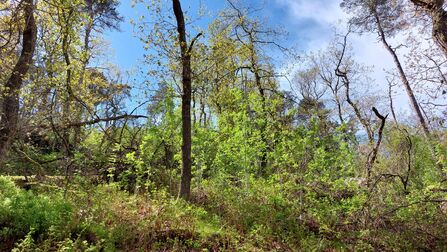
Natural tree regeneration at Back Forest by Roz Lees
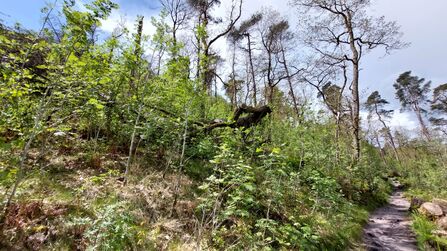
Natural tree regeneration at Back Forest by Roz Lees
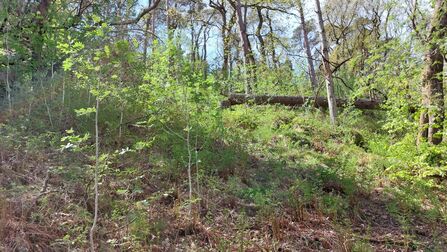
Natural tree regeneration at Back Forest by Roz Lees
Other work at The Roaches
During winter 2023 we installed a rustic fence around Doxey Pool, which sits not too far from the trig point. The pool edges were badly eroded (see the first two images) and it wasn’t a great space for wildlife at all. Fencing the pool has improved the water quality, reduced erosion around the edges and allowed vegetation to grow/recover. The pool now provides better quality habitat for various peatland invertebrates and plants.
The water quality would never have recovered while the pool was unfenced as it was continuously used by passing dogs (sometimes people too). Wildlife needed both to stop. We had to put wildlife first as dogs can also add harmful chemicals to the water in the way of flea treatments and shampoo.
The images below show how it looked before the work, and how it’s looking as of summer 2026. It’s great to see it recovering and beginning to flourish, just two years on! When we took these updated images the water levels were low due to the drought but it has since quickly refilled with the arrival of wetter weather.
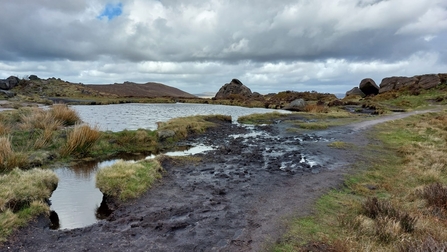
Doxey Pool is in very poor ecological condition (2023) and we need to act to turn things around. It has no wildlife, yet it should support various peatland invertebrates and plants.
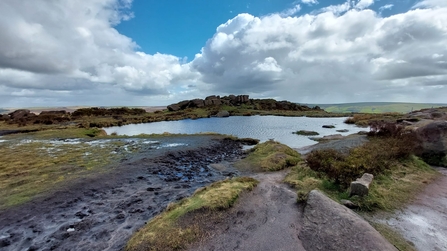
We hope that by fencing Doxey Pool that vegetation will be able to grow around the banks and the water quality will improve to support wildlife.
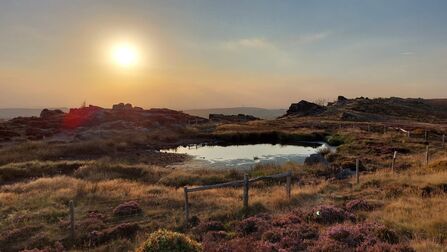
2026: Vegetation is growing around the banks of Doxey Pool and the water quality is beginning to improve, better supporting wildlife.
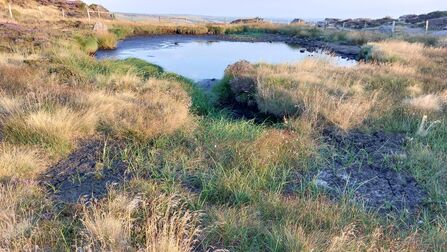
2026: Vegetation is growing around the banks of Doxey Pool and the water quality is beginning to improve, better supporting wildlife.

Christine Harding
Explore our reserves
We care for over 40 nature reserves spanning over 1,900 hectares. Head to our reserves page to find out more about these special places.